
This section of the Google SEO Starter Guide will walk you through the process in a simple way. When I first wanted my website to show up on Google I did what most people do. I looked up “how to rank a website” on Google. I got a lot of advice, expensive classes and terms that I did not know. Then I found something that unexpected- a surprisingly helpful guide created by google . The Google SEO Starter Guide explains what Google looks for when ranking websites. In this section, we will explore how to use the Google SEO Starter Guide step by step. The Google SEO Starter Guide helps you understand the exact steps needed to improve your website’s ranking.
Why the Google SEO Starter Guide is important for Beginners
The Google SEO Starter Guide is a great place to start for beginners. Most people who are new to this do not know that it exists or they think it is too simple to be helpful. If you are a beginner, you can also learn basic seo techniques to build a strong foundation. This guide is actually very helpful and easy to understand. If you follow the steps in the Google SEO Starter Guide, you can clearly understand how Google ranks website. It is a reliable starting point for anyone who wants to improve their website’s visibility. Overall, the Google SEO Starter Guide gives you a clear path to improve your ranking step by step.
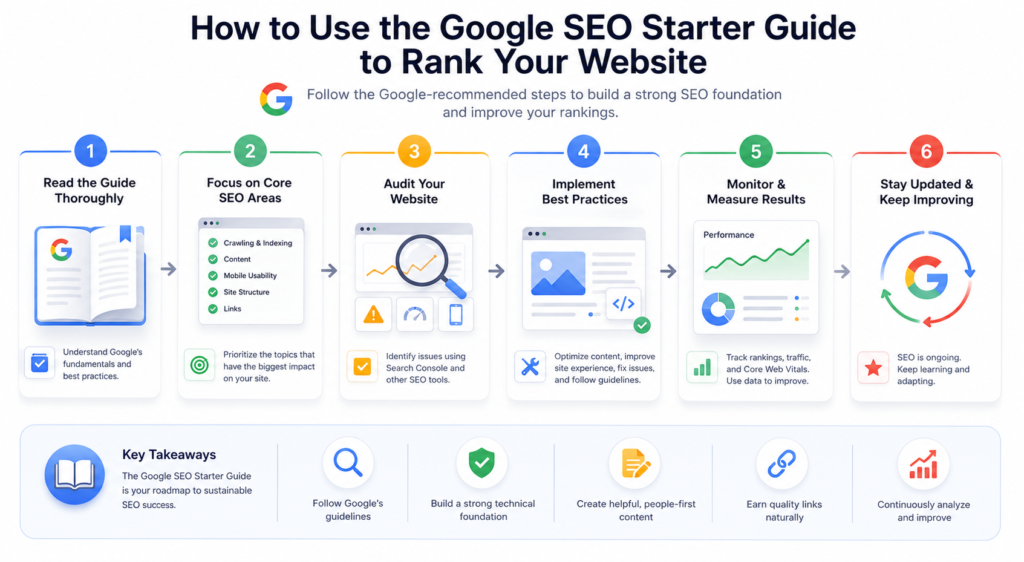
What Is the Google SEO Starter Guide?
The Google Search Central team has released an official paper called the Google SEO Starter Guide. It discusses the fundamental ideas behind Google’s crawling, indexing, and ranking of online sites.
It’s not a set of tips. It is a foundation for creating websites that are trustworthy and comprehensible to both search engines and actual users. Most novices are unaware of how important that distinction is matters more than most beginners realize. The Google SEO Starter Guide helps beginners understand SEO easily.
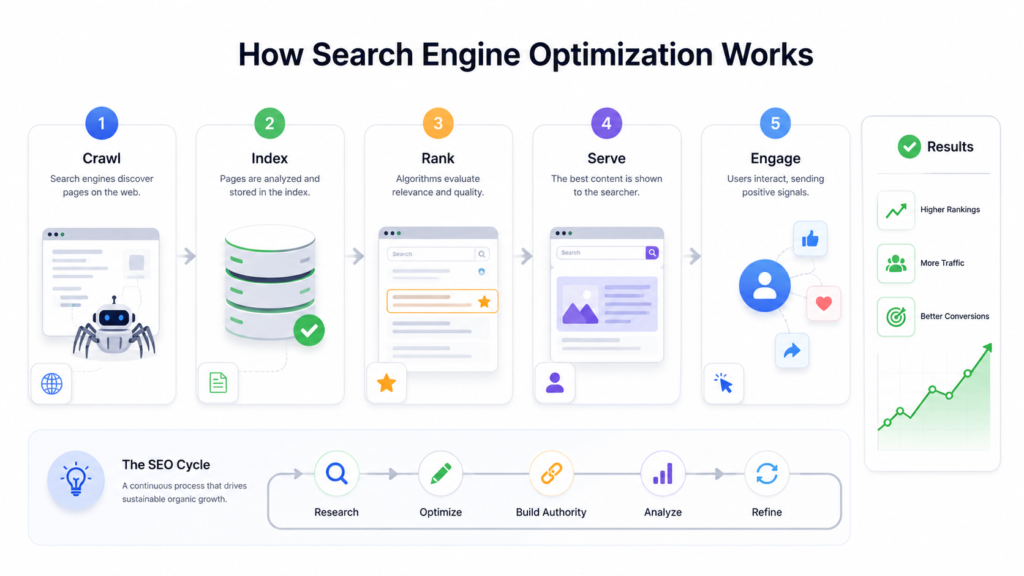
Step 1: Understand What Google Is Actually Trying to Do
Google aims to provide its consumers with the most useful, relevant, and reliable result for any given search, so take this into consideration before you touch a single header tag or meta description.
It is not your responsibility to deceive Google. It is your responsibility to make it simple for Google to comprehend the purpose of your page and to demonstrate that your material actually benefits users.
This is made extremely evident in the first portion of the Starter Guide. Gaming an algorithm is not the goal of SEO. It has to do with usefulness, organization, and clarity. Every other strategy made sense to me after that.
Step 2: Start With Your Site Structure
The advice highlights that before Google can rank your website, it must be able to crawl and index it. Nothing else counts if Google’s bots are unable to locate or read your pages.
How to proceed:
Make sure the structure of your website is logical and obvious. Think of it as a library, where every page is easily accessible and every topic has its own section.
Make a sitemap and upload it to Google Search Console (the majority of website platforms, such as WordPress or Squarespace, automatically create this).
Verify that your pages are not inadvertently set to “noindex”—a common novice error that completely prevents Google from viewing your material.
Step 3: Write Page Titles and Meta Descriptions That Actually Describe the Page
This is where the majority of novices either ignore it entirely or overthink it.
The Starter Guide is simple: your meta description should entice users to click, and your title tag should appropriately convey the topic of the page.
Useful advice:
To avoid being truncated in search results, keep titles under 60 characters.
Place your primary keyword close to the start of the title; it shouldn’t be crammed in uncomfortably. Compose one-sentence pitch-style meta descriptions. If the reader clicks, what will they get?
Step 4: Create Content That Answers Real Questions
For good reason, the handbook devotes a large amount of emphasis to content quality. Google’s algorithms are now extremely adept at differentiating between genuinely beneficial information and filler.
Here, E-E-A-T stands for Experience, Expertise, Authoritativeness, and Trustworthiness. Google seeks to prioritize material authored by experts.
For novices, this implies:
It is more important to write about what you are actually learning or doing as a novice than to pretend to be an expert when you are not.
Give specifics. Words like “create great content” are useless. Give examples to illustrate how.
When appropriate, cite reliable sources and include links to them.
When things change, update your content. Trust is damaged by outdated information.
Step 5: Use Headings to Organize Your Content Logically
To establish a distinct content hierarchy, the Starter Guide suggests use header tags (H1, H2, H3). This facilitates speedy site navigation for both Google and human users.
Basic guidelines:
Each page should have one H1.
For important portions, use H2s.
For sub-points in those sections, use H3s.
Headings should be descriptive. “Step 3” provides no information. “Step 3: Optimize Your Page Titles” lets everyone know exactly what’s about to happen.
Step 6: Optimize Your Images
Every image on your website should include a descriptive alt text tag. This is a detail that many novices overlook. In addition to improving your website’s accessibility for people with visual impairments, this helps Google comprehend what the image depicts.
Make your alt text succinct and informative. “image1.jpg” has no meaning.”Google Search Console coverage report screenshot” has some significance.
Before uploading, make sure your photos are compressed. website speed is a known ranking element, and large picture files make your website slower.
Step 7: Build Links — Internal First, Then External
According to the guide, Google finds and evaluates fresh information through links.
Include links to pertinent previous blog entries on your website whenever you write a new one. This distributes ranking authority throughout your pages and aids Google in comprehending the structure of your website.
One of Google’s most powerful ranking factors are external backlinks, which are links from other websites that point to yours. These are outside your complete control, however you can acquire them by:
Creating material that is worth citing
Guest posting on pertinent websites
listing your website in reputable specialist directories.
Step 8: Make Your Site Mobile-Friendly and Fast
Google now employs mobile-first indexing, which means that it ranks your website based mostly on its mobile version. Your rankings will suffer if your website appears broken or loads slowly on mobile devices.
Fast checks:
Take the Google Mobile-Friendly Test
Run PageSpeed Insights on your website and address any high-priority issues.
Make use of a responsive website theme (the majority of contemporary themes take care of this automatically).
Common Beginner Mistakes to Avoid
Upon closely examining the Starter Guide, a few preventable errors become apparent:
focusing on very competitive keywords too soon. Before pursuing general terms, start with particular, lower-competition phrases (long-tail keywords).
Google Search Console is being ignored. It shows you exactly how Google views your website and is both strong and free.
After publishing once, leave. The game of SEO is a long one. Regular updates and consistency are important.
writing for algorithms rather than for human readers. Your content will execute abnormally if it reads abnormally.
FAQs
How long does it take to use the Google SEO Starter Guide to rank a website? Assuming persistent work, most new websites take three to six months to start receiving significant organic traffic. For terms with little competition, some pages score higher than others.
Can a website rank with the Google SEO Starter Guide alone? It goes into great detail on the basics. The Starter Guide is the best place to start, but you’ll eventually want to delve deeper into subjects like technical SEO, link building, and keyword research.
Is the Google SEO Starter Guide updated? Indeed. Google changes it on a regular basis. For the most recent version, see the official page.
Final Thoughts
You won’t become an SEO expert overnight with the Google SEO Starter Guide. It will provide you with an honest, transparent foundation that is based on the same criteria that Google uses to rank websites.The best thing you can do as a novice is to read it, use it often, and fight the urge to take shortcuts. Long-term ranking websites are those that are created for actual people, contain real information, and are kept up to date by people who are concerned about accuracy.
Go there first. It serves as the foundation for everything else.